
New: skills and code execution
Archestra 1.3 "Lyra" brings Skills to the platform: a central catalog, sandboxed code execution, and governance.
2026-07-06 · Joey Orlando
Anthropic introduced "Skills" last year, and they immediately took off in the personal agent space. Soon every client we know supported the standard: OpenAI Codex, GitHub Copilot, Cursor, Google's Gemini CLI, and dozens more. Companies like Atlassian, Figma, Stripe, Notion, and Cloudflare publish partner-built skills. It's essentially the same format everywhere — a folder with a SKILL.md.
Companies ended up with silos: amazing skills distributed across developer machines, and GitHub repositories with no promotion mechanisms, no governance, and limited visibility.
Archestra 1.3 "Lyra" is our answer: skills, centralized across your enterprise 🎉
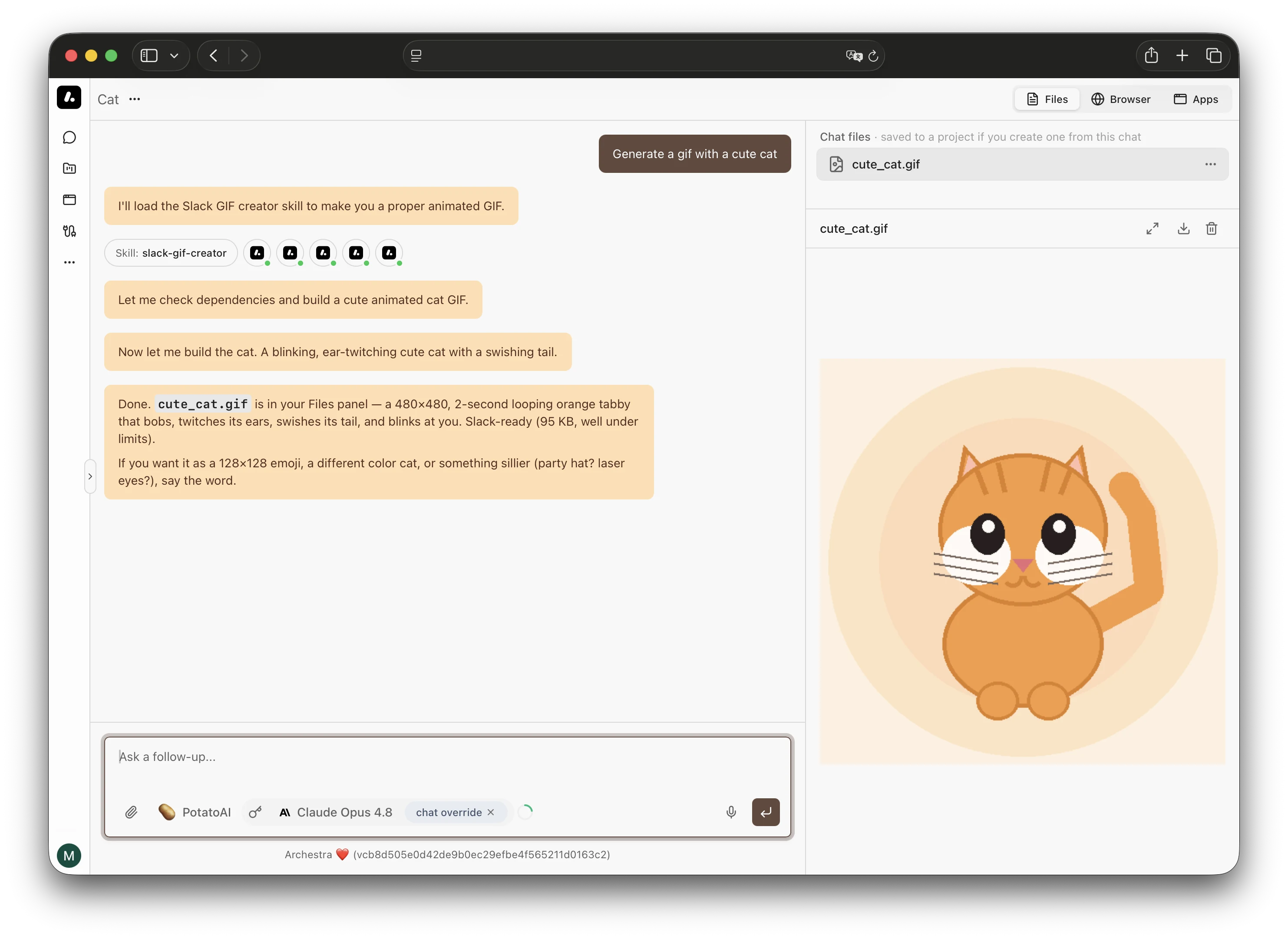
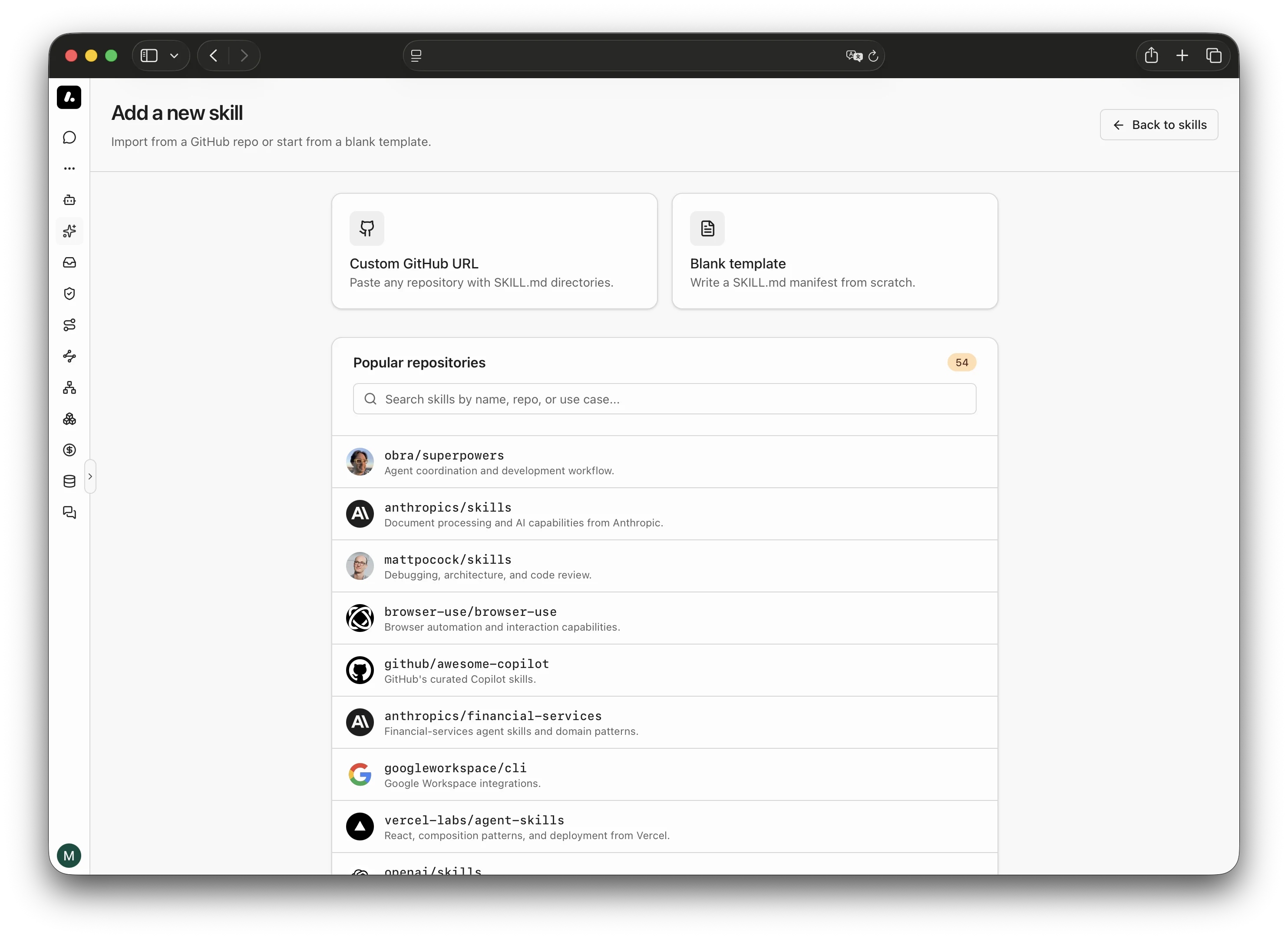
Non-technical users get them in the agentic runtime; developers get an internal skill catalog for Claude Code, Codex, and other agents.
Skills come with code — so we ship a runtime
Skills are not only prompts. Take Anthropic's own pdf skill — the one behind Claude's PDF handling:
pdf/
├── SKILL.md                        # when to use it, quick-start instructions
├── forms.md                        # form-filling guide, read on demand
├── reference.md                    # advanced features, read on demand
└── scripts/
    ├── fill_fillable_fields.py     # fills a PDF form from field values
    ├── extract_form_field_info.py  # lists a form's fields and their types
    ├── convert_pdf_to_images.py
    └── ...                         # eight scripts in total
The SKILL.md carries the judgment calls; the bundled Python scripts carry the mechanics. For the skill to be useful, an agent has to actually run that code — and that's the hard engineering half of the feature.
So alongside skills, Archestra 1.3 ships a code execution runtime built on Dagger. Calling
load_skill mounts the skill's files into the conversation's sandbox, and every command the agent runs becomes a cached, replayable container layer.We chose Dagger because it gives us millisecond warm-up time per code run, stays lightweight, and still lets us enforce the security measures we need — for example, environment-specific network policies. The full mechanics are in the code sandbox docs.
What makes it enterprise-ready?
First, we've embedded promotion mechanisms into skills. By default, they are personal. Once they're ready, they can be promoted and deployed across a team or the whole organization.
Second, a skill's code runs in a sandbox bound to an Environment, the same construct that scopes your MCP servers. The sandbox inherits the environment's network egress policy. Tool calls follow the deterministic guardrail policies.
The last bit is where we spent most of the time: skills locked inside Archestra wouldn't make any sense, so we made sure skills can move between Claude Code, Codex, and the central catalog in both directions. That's a big topic I'm proud of — more on it in a separate post later this week.
Getting started
Archestra 1.3 "Lyra" is out today — update to the latest version and skills are there: import one from GitHub, or start from a blank SKILL.md.